

What AI agents really are (and 5 ways businesses use them today)
7 min read
AI agents are the most talked about idea in software right now, and one of the most misunderstood. Stripped of the hype, an agent is simple to describe: it is an AI system that can take actions and use tools to complete a multi step task, not just answer a single question. Here is what that means in practice, and where it is genuinely useful today.
From answering to doing
A normal AI assistant responds to one prompt with one answer. An agent goes further. Given a goal, it can plan the steps, take an action, look at the result, and decide what to do next, repeating until the goal is met. The difference is between a model that tells you how to do something and a system that actually does it.
The agent loop
Most agents follow the same basic loop. They perceive the request, reason about a plan, act by taking one step (often by calling a tool), observe the result, and then loop again with that new information.
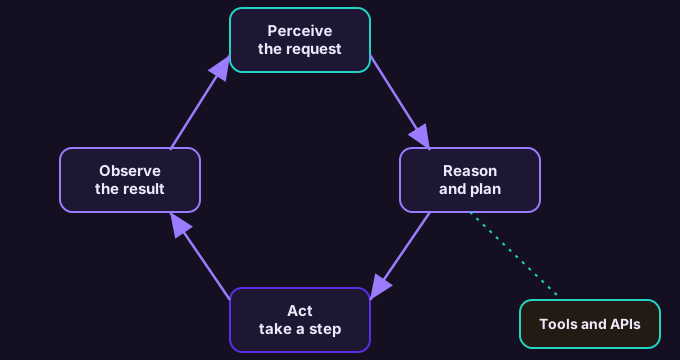
The key ingredient is tools. An agent becomes useful when it can do more than talk: search a knowledge base, query a database, call an API, send an email, create a ticket, or run a calculation. The model decides which tool to use and when; the tools do the real work in the outside world.
Plain definition: an AI agent is a model plus tools plus a loop. The model reasons, the tools act, and the loop lets it work through several steps toward a goal.
Five ways businesses use agents today
- Customer support resolution. Not just suggesting a reply, but checking an order status, processing a return, and updating the ticket.
- Document processing. Reading an inbound email and its attachments, classifying them, extracting the key fields, and filing them in the right system.
- Research and reporting. Gathering information from several sources, synthesising it, and producing a draft report.
- Sales and operations assistants. Pulling data from a CRM, preparing summaries, and drafting follow ups for a person to approve.
- Internal workflow automation. Connecting steps that used to need a human to copy data between tools.
Where to be careful
Because agents take actions, the stakes are higher than with a chatbot. A good agent has guardrails: limits on what it is allowed to do, a human approval step before anything irreversible, logging so you can see what it did, and a safe fallback when it is unsure. The aim is not an agent that runs wild, but one that handles the routine reliably and asks for help at the edges.
Agents are not magic, and they are not right for every task. But for multi step, tool using work that used to require a person to glue systems together, they are quickly becoming one of the most practical applications of AI in business.