

RAG explained: how to make AI answer reliably from your own data
7 min read
Ask a general AI model about your business and it will answer confidently, and sometimes wrongly, because it has never seen your data. Retrieval augmented generation, or RAG, is the technique that fixes this. It is how you get an AI assistant that answers from your documents, your policies, and your product, rather than from the open internet.
The problem RAG solves
Large language models are trained on general text up to a point in time. They do not know your internal handbook, your latest pricing, or last week's support tickets. Ask about those and the model may guess. For a business, a confident wrong answer is worse than no answer. RAG removes the guessing by giving the model the right facts at the moment it answers.
How RAG works
The idea is simple. Instead of relying on what the model memorised, you retrieve the most relevant pieces of your own content for each question and hand them to the model along with the question. The model then writes its answer using those facts.
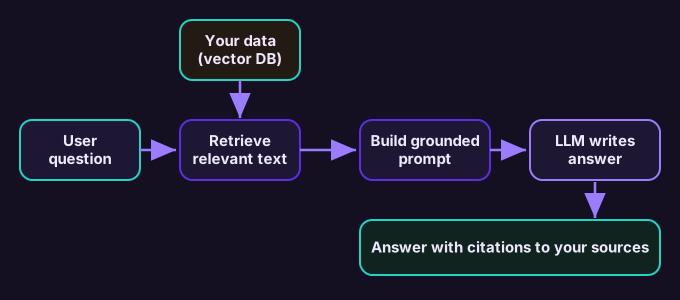
Step by step:
- Prepare your content. Your documents are split into chunks and converted into vectors (numerical representations of meaning) stored in a vector database.
- Retrieve. When a question comes in, it is turned into a vector too, and the database returns the chunks closest in meaning. This is semantic search: it finds by meaning, not just matching keywords.
- Augment. The retrieved chunks are added to the prompt, with instructions to answer only from the provided context.
- Generate. The model writes a grounded answer, ideally citing which sources it used.
Why this matters: RAG keeps answers current (update the data, not the model), grounded (answers trace back to your sources), and controllable (you decide what the model can see).
Where RAG shines
- Internal knowledge assistants that answer staff questions from policies and documentation.
- Customer support that drafts accurate replies grounded in your help content.
- Document analysis over contracts, reports, or research, with citations.
- Product and onboarding assistants that explain your own product, not a generic one.
Getting it right
RAG is simple in concept and full of details in practice. The quality of answers depends on how you chunk content, how good the retrieval is, how the prompt is written, and how you handle cases where the answer is not in the data (the system should say so, not invent one). Good RAG also keeps a human in the loop for high stakes answers and respects who is allowed to see which documents.
Done well, RAG turns a clever general model into something far more valuable: an assistant that knows your business and can prove where its answers came from.