

Modernising legacy software without the downtime: a practical playbook
8 min read
Every growing company eventually inherits software that is holding it back: a system that is slow to change, expensive to run, and risky to touch. The instinct is to rebuild it from scratch. That instinct is usually wrong. Here is how to modernise legacy software safely, without the downtime and the failed big-bang rewrite.
Why the big rewrite usually fails
Rewriting a critical system from zero sounds clean, but it is one of the riskiest moves in software. The old system kept running the business while you spent months or years rebuilding it, and on switch-over day you discover all the edge cases it quietly handled. Meanwhile no new features shipped. The big-bang rewrite trades a known, manageable problem for a large, hidden one.
A safer pattern: strangle, do not replace
The proven alternative is to modernise gradually. You place a router in front of the old system, then move one capability at a time into new, well-built services. Each piece is migrated, tested, and switched over on its own. The old system shrinks as the new one grows, until it can be retired. There is never a single dangerous switch.
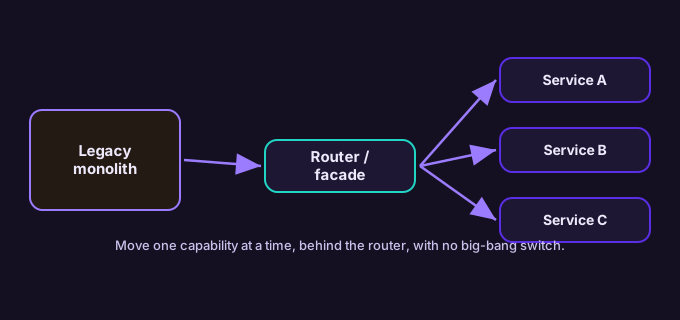
The benefit: the business keeps running throughout, risk is spread across many small steps, and you can pause or reprioritise at any point.
How to approach it
- Map and prioritise. Understand what the system does and pick the capability where modernisation gives the most value with the least risk.
- Put a seam in place. Introduce a router or facade so traffic can be redirected without callers noticing.
- Rebuild one capability. Implement it as a clean, well tested service with modern architecture and observability.
- Switch over safely. Route a small share of traffic first, watch it closely, then ramp up. Keep the old path as a fallback.
- Repeat, then retire. Move the next capability, and the next, until the legacy system can be switched off.
What good looks like afterwards
Modernisation is not only about new technology. The payoff is a system that is faster to change, cheaper to run, easier to scale, and safer to operate, with automated testing and monitoring built in. Teams ship features again instead of fighting the old code.
We have used this approach to modernise systems in healthcare, finance, and other demanding domains, including rebuilding a legacy platform into a modern microservices stack with full functional parity. The lesson is consistent: you do not have to choose between keeping the lights on and moving forward. Done in steps, you can do both.